


Organized by

Supported by
Invited by
- November 14
- One full Saturday, from 8:00 AM to 8:00 PM
- In-person in Bogotá
- Universidad de los Andes campus
- COP 2,000,000 in prizes
- Three winning teams selected by the judges at the close of the sprint
The Idea: Defensive Acceleration (def/acc)
AI systems are rapidly advancing in capability and autonomy: tool-using agents connected to terminals, browsers, and MCP servers can be hijacked via indirect prompt injection; increasingly capable models raise the challenge of how to oversee them if they act deceptively or attempt subtle sabotage; and automated vulnerability discovery and synthetic impersonation strain digital infrastructure and epistemic trust.
Defensive acceleration (def/acc) in AI safety proposes building and validating technical and institutional defenses that tilt the balance back toward defenders: resilient agent architectures, AI control and monitoring protocols, automated cyberdefense and formal software verification, cryptographic provenance, and standards for securing frontier model weights and critical infrastructure.
Real-World Context
In Colombia and Latin America, these risks are already concrete (from attacks on public infrastructure and WhatsApp voice-cloning fraud to the rapid deployment of autonomous agents without guardrails), while our technical community has the talent to contribute empirical solutions to the global AI safety frontier.
The Challenge
Build and evaluate, within 8 hours of focused teamwork, a defensive prototype or verifiable standard across one of the 6 research tracks: agent security, AI control & oversight, automated cyberdefense & formal verification, epistemic defense, AI infrastructure security & governance, or multi-agent risks.
The 4 Core Questions for Every Submission
1
The threat vector: clearly define which attack vector, control failure, or AI vulnerability your project mitigates.
2
The defensive mechanism or protocol: build the prototype, oversight monitor, formal verifier, or technical-regulatory standard that contains the threat.
3
Empirical validation: measure effectiveness using benchmarks, test suites, or concrete scenarios (mitigated attacks, detection rate, false positives, or verified invariants).
4
Limitations & dual-use: honestly document failure modes and ensure the work cannot be weaponized.
Who Can Join?
- Undergraduate & graduate students from any discipline, researchers, software engineers, and public policy practitioners.
- Participants must be 18 or older. We do not accept minors.
- Teams of 2 to 5. Solo applicants are grouped during the opening session at 8:30 AM.
- Oracle Academy only activates with an @uniandes.edu.co email: teams that want it need a Uniandes member. If you don't have one, we'll help you find one during team formation.
- No prior AI safety research experience required: each track provides accessible entry points (solvable with Python, guided evaluation suites, or formal threat modeling and governance without code in Track 5).
- Limited capacity to ensure a good workspace and catering.
Prizes · COP 2,000,000 total
Judges will evaluate submissions and determine the top three projects at the conclusion of the sprint.
1,000,000 500,000 500,000

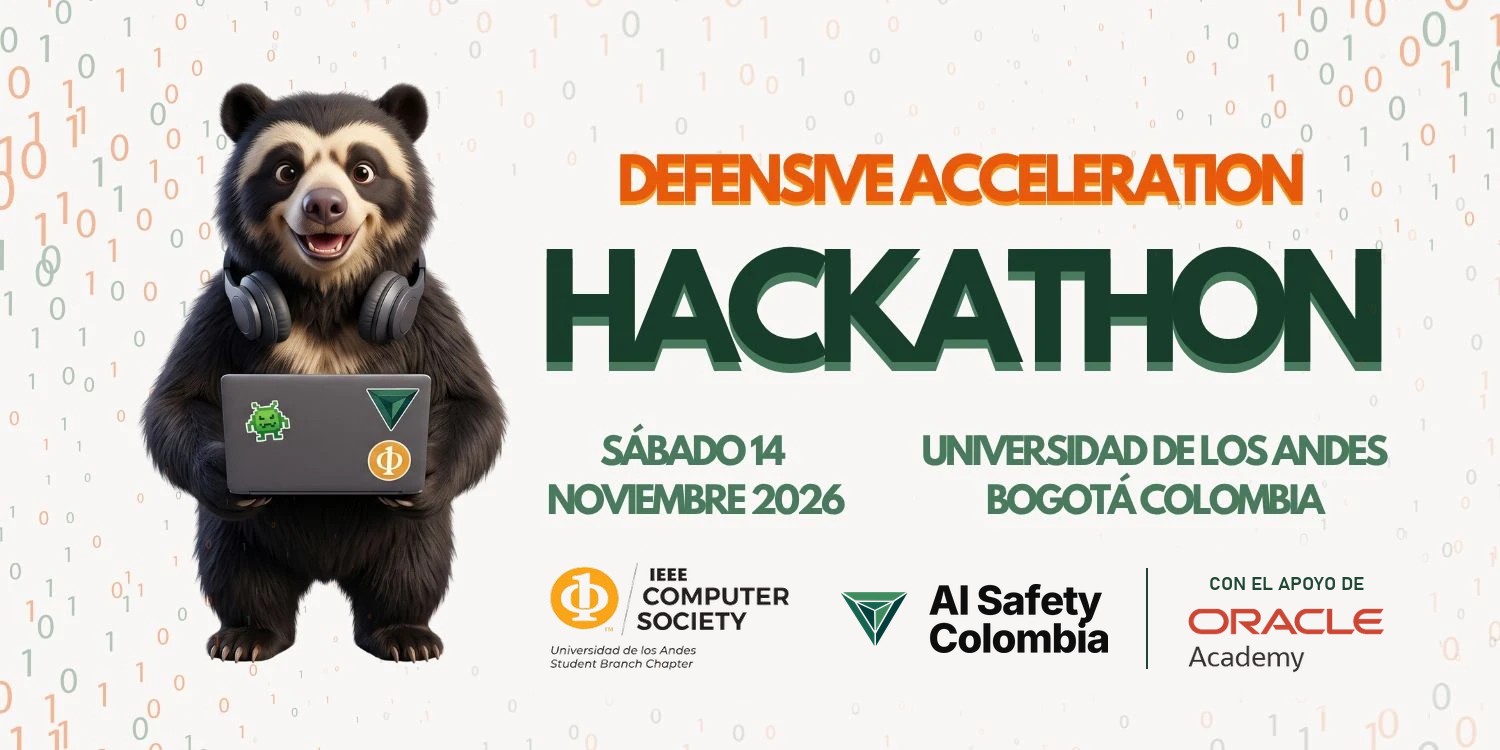
Our Mascot: The Andean Spectacled Bear
The spectacled bear (Tremarctos ornatus) is South America's only native bear species. Its distinctive facial rings reflect our defensive mission: spotting threats before they cause harm.
Judges and mentors
Mentors support the teams throughout the day, and judges, researchers and practitioners in AI safety, cybersecurity, and governance, evaluate submissions at the close of the day.
 Judge
Christian Urcuqui
Cybersecurity and AI researcher at TryHackMe. Lecturer at Universidad Icesi and co-author of three books on cybersecurity. He published AgentBreak, an indirect prompt injection lab for LLM systems.
Research fellow at SPAR, where he builds red-teaming environments in which attacks and monitors co-evolve. Lead AI/ML Engineer at CRSS and former lecturer at the University of Costa Rica.
Research fellow at SPAR, building a testbed to measure how AI agents negotiate: when deals fail and how a crisis escalates between them. He studies economics at the Universidad Autónoma de Nuevo León.
 Judge
Jose Felipe Duarte
Researcher at the Universidad Tecnológica de Pereira and AI engineer at LRC. First author of PsychoAlign, an alignment architecture with three negotiating agents, presented as an oral at LatinX in AI @ ICML 2026.
 Judge
Manuela Chacón
PhD student in Engineering at the Universidad de los Andes and a Google DeepMind scholar. First author of an IEEE paper on cooperative resilience in multi-agent systems; in 2025 she took part in the Cooperative AI Summer School.
 Judge and mentor
Jairo Torregrosa
Sr AI Research Engineer at Mercado Libre (GenAI Engineering Research) and Claude Community Ambassador in Bogotá, where they teach agent workshops on the Agent SDK and Managed Agents. Publishes agent tooling and open evals.
 Mentor
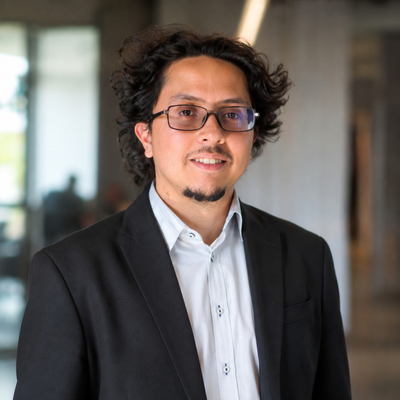
Robert Gómez
CTO of AIMEDIC, which brings generative AI to clinics and hospitals. Co-author of a Universidad Nacional study on health assistants for teenagers and researches tax loopholes with MIT at LoopholeCheck.
 Mentor
Pablo Pastrana
Product Lead at Dapper, a Colombian regtech that uses AI to track legislative and regulatory changes in Latin America, named among Fast Company's most innovative companies of 2026. Its MCP connector is in Claude's official directory.
 Mentor
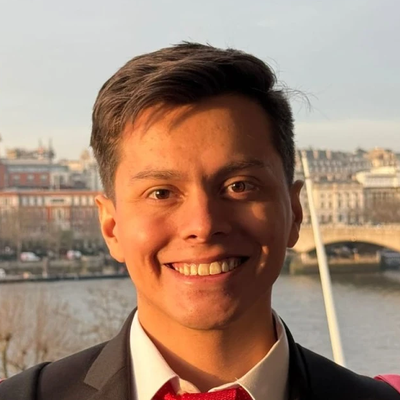
Santiago Calderón
AI engineer at Factored and explainable AI researcher. During an MSc at King's College London, built IncX, which explains object detector decisions in video in real time. Co-authored an ECAI 2025 paper on brain MRIs.

Sponsorship
Oracle Academy supports this hackathon: participants get a certification and access to Oracle Academy tools to build their project. They only activate with an @uniandes.edu.co email, so teams need a Uniandes member; we'll help you find one during team formation. More details soon.